I know this is a mostly movie blog, so I’ll find a way to connect this to film, but this entry is actually about some storytelling I found while in my Bible this morning.
I was reading Job—deep in one of those poetic monologues where Job is marveling at God’s power—and I hit a line that made me pause:
“By his understanding he shattered Rahab.” (Job 26:12)
At first glance, I thought: Rahab?
Wasn’t she the woman from Jericho who helped the spies in Joshua?
I also really just wish job was spelled “jobe” because this is really just reminding me of the absolute rut i’ve been in for the last few years trying to find a better J-o-b.
and now job, or “job,” doesn’t even sound like a word. and neither does “rahab,” but I knew I’d heard it before.
But this Rahab was different.
This Rahab was shattered.
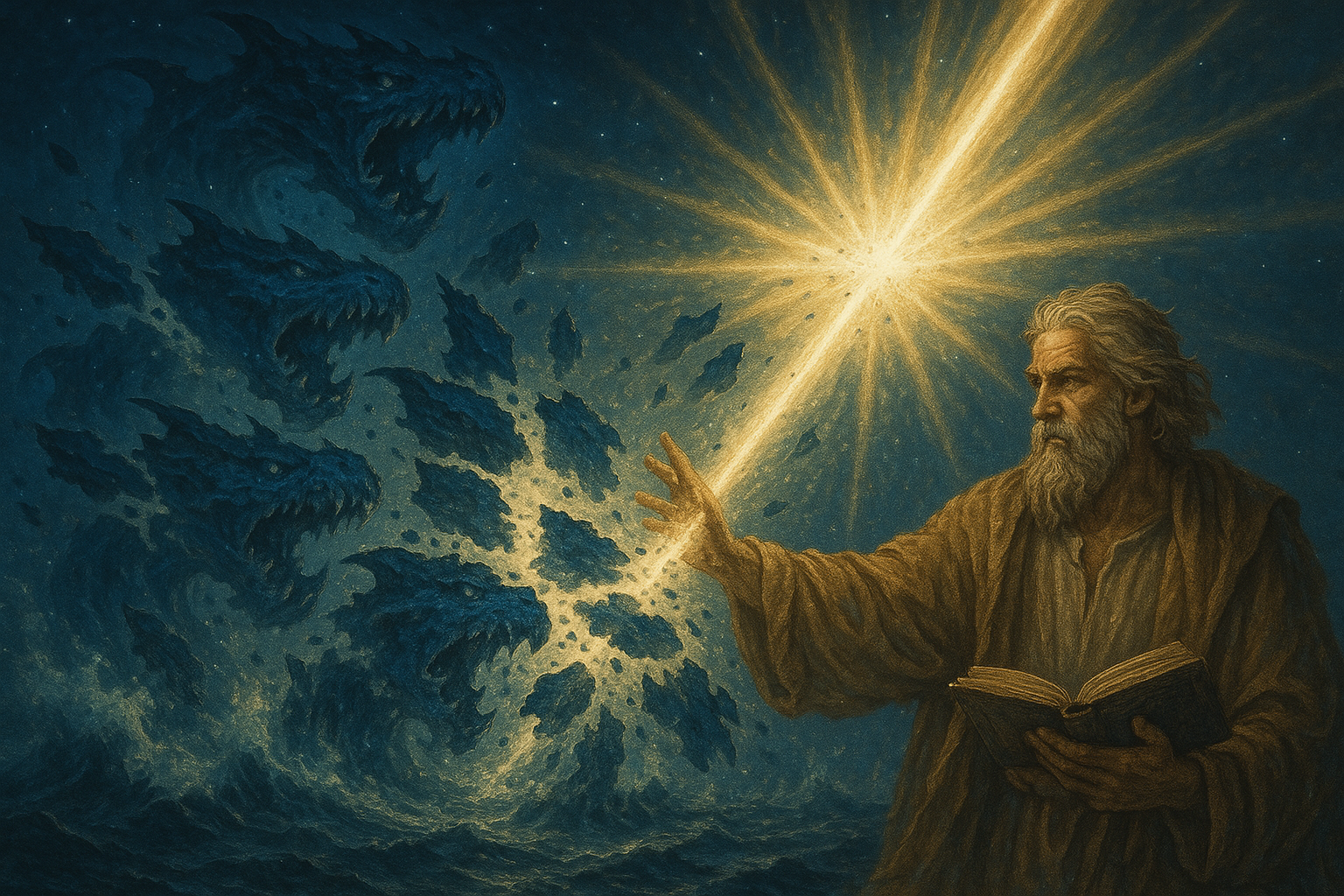
That one sentence sent me down a rahab hole of research and reflection—and eventually, a long conversation with ChatGPT (yes, really). It turns out Rahab here isn’t a person. It’s something far bigger:
A symbol of chaos.
A mythic sea monster.
A poetic representation of everything proud, violent, ancient, and terrifying.
To ancient readers, “Rahab” would have conjured images of a towering, sea-born beast—part hurricane, part dragon, part rebellion. Every culture in that region had a version of it: Babylon had Tiamat. The Canaanites had Yam. Even Israel’s poetic tradition used Rahab and Leviathan as metaphors for the forces that resist God’s order and threaten peace.
And yet Job says—almost casually—that God shattered Rahab.
With wisdom.
“By his power he stilled the sea;
by his understanding he shattered Rahab.” (Job 26:12, ESV)
That hit me in a new way.
Because I know what it feels like to be overwhelmed by chaos—inner storms, outer storms, suffering that makes no sense. The idea that God doesn’t just overpower those things with brute force, but with wisdom… that’s something different. That’s something beautiful.
It means God isn’t just stronger than our chaos—
He’s smarter than it.
He understands what we don’t.
And even when we see no clear answers, we can still trust the One who once silenced a monster with just His understanding.
✍️ What I’m Taking With Me
• Some of the Bible’s most powerful truths are hidden in strange words I’ve skipped over.
• Asking questions—especially the ones that make me feel a little lost—is not a sign of doubt, but often the doorway to deeper faith.
• Even the ancients knew chaos. They just had different names for it.
• And God? He’s been calming that chaos long before I had words for mine.
⸻
Want to join me as I keep chasing these ancient phrases and seeing what they still have to say to modern hearts?
This is the first entry in a new series I’m starting:
Ancient Psalms, Modern Hearts
Because poetry ages well. And so does truth.
And since this is technically a mostly movie blog, check out the film called “The Shift.” It’s inspired by the book of Job, and it has Neal McDonough playing the devil and Sean Astin as a totally different type of goonie.
I saw “the shift” a couple summers ago, and it caught me at a time when I really needed it. It’s a good watch, and it might even inspire you to look into how accurate it is to the biblical story of Job (like it did for me).
When I can get a movie to motivate me to get back into my Bible, I know I’m doing something right. Plus, it can be really fun sometimes to take something that’s seemingly secular and see how it secretly seeks our Savior. maybe I’ll start a blog series about the secular songs that I repurpose for worship.
I don’t know how to end this, so I’ll say don’t be discouraged. have faith (especially if you’re actually reading the book of Job, it’s mostly just dudes complaining).